 Spacewhale
 funding rates for holding decisions
Funding helps assess the cost or credit of holding a SpaceWhale perpetual position. Rates depend on market and collateral, and they change unrealized profit or loss.
- Calculation interval
- Hourly, using each market and collateral asset’s open-interest imbalance.
- Collateral
- ETH or USDC; position profits and losses use the same collateral asset.
- Funding Factor
- The market’s yearly rate at completely one-sided open interest, distinct from its hourly funding rate.
Comparing holding periods
Open-interest changes can alter the rate, so one reading can’t establish the cost of a longer hold.
The API documentation separates the current
funding_rate
from
next_funding_rate
, its prediction for the next update. Funding credits don’t guarantee overall profit; price losses and the market’s liquidation threshold still matter.
Interpreting payment direction
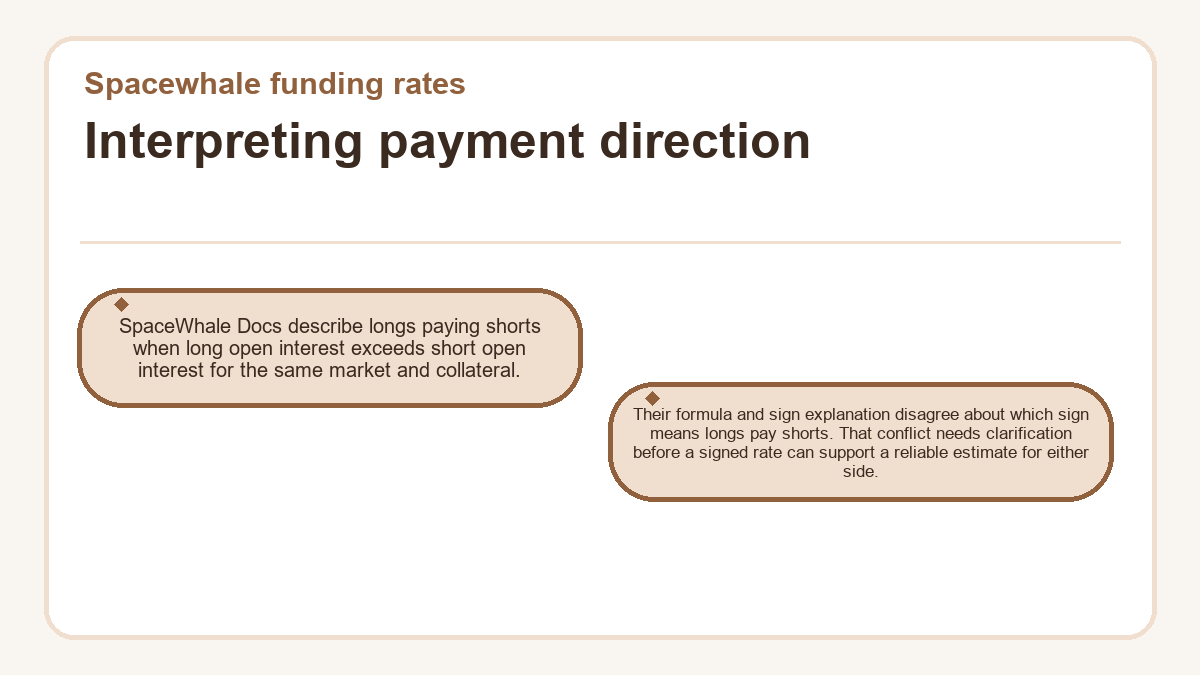
SpaceWhale Docs describe longs paying shorts when long open interest exceeds short open interest for the same market and collateral. Their formula and sign explanation disagree about which sign means longs pay shorts. That conflict needs clarification before a signed rate can support a reliable estimate for either side.
Assessing an exit
If funding costs no longer fit your holding plan, an opposite-direction reduce-only order reduces the position only when it executes; submission alone doesn’t establish a completed exit.